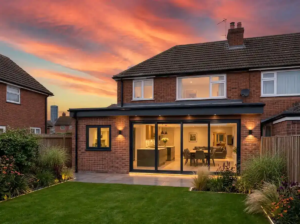
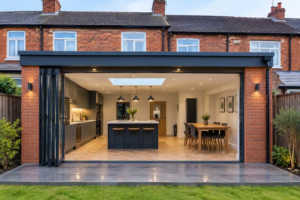
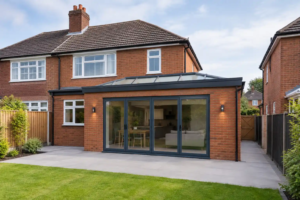
A rear extension extends your home into the back garden. A side return extension fills the unused side alley beside your house. Rear extensions add more space overall. Side returns work best for terraced and semi-detached homes with narrow gaps.
Both create bigger, brighter living areas. The right choice depends on your property type and garden size.
Key Takeaways
- Rear extensions extend into the garden; side returns fill unused side alleys.
- Rear extensions typically add more overall space than side returns alone.
- Side return extensions usually require full planning permission, unlike many rear extensions.
- Combining both creates a popular “wraparound” extension for terraced homes.
- Property type and garden priorities should guide your final decision.
What is a Rear Extension?
A rear extension adds new space at the back of your home. It usually extends into the garden.
Most rear extensions create open-plan kitchen-diners. Or larger living rooms with garden views.
They suit almost any property type. Detached, semi-detached, and terraced homes can all benefit.
What is a Side Return Extension?
A side return extension fills the narrow strip of land beside many Victorian and Edwardian terraces.
This “dead space” often sits unused, running down one side of the house.
Building into it widens your kitchen or living space significantly. Without touching your garden at all.
Key Differences Between Rear and Side Return Extensions
| Factor | Rear Extension | Side Return Extension |
| Location | Extends into back garden | Fills side alley space |
| Best suited to | Any property type | Terraced, semi-detached homes |
| Garden impact | Reduces garden size | No garden lost |
| Typical size | 15–30m² | 5–15m² |
| Average cost (Birmingham) | £25,000–£45,000 | £20,000–£35,000 |
| Planning permission | Often Permitted Development | Usually needs planning permission |
Which Adds More Space: Rear or Side Return?
Rear extensions typically add more overall space. They’re not limited by an existing alley’s width.
Side return extensions add smaller amounts of space. But that space often transforms an awkward layout completely.
Combining both is increasingly popular. This creates a full-width, open-plan ground floor.
Do You Need Planning Permission for Either Extension?
Rear extensions often qualify under Permitted Development rights. This means no planning application needed.
Limits usually apply, though. Single-storey rear extensions can extend:
- Up to 4 metres for detached homes
- Up to 3 metres for semi-detached and terraced homes
Side return extensions more commonly require full planning permission. This is because they change your building’s footprint sideways.
Always confirm current rules with your local Birmingham council. Permitted Development rights can be withdrawn on some properties.
How Much Does Each Extension Type Cost?
Costs depend on size, finish and structural complexity involved.
Rear extension costs:
- Basic finish: £1,500–£2,000 per m²
- Mid-range finish: £2,000–£2,500 per m²
- High-end finish: £2,500+ per m²
Side return extension costs:
- Basic finish: £1,800–£2,200 per m²
- Mid-range finish: £2,200–£2,800 per m²
Side returns often cost more per square metre. Narrow spaces mean higher labour complexity relative to size.
Which Property Types Suit Each Extension?
Rear extensions suit:
- Detached and semi-detached houses with garden space
- Bungalows extending living areas
- Any home with unused rear garden depth
Side return extensions suit:
- Victorian and Edwardian terraces
- Semi-detached homes with a side alley
- Properties where garden space is limited or valued
If your terrace has a side alley, this option deserves serious consideration.
Can You Combine a Rear and Side Return Extension?
Yes, and it’s one of the most popular choices for Birmingham terraces.
This “wraparound” extension combines both spaces into one seamless area. It creates maximum floor space.
One JMA Group client in Kings Heath combined both extension types. Their kitchen-diner grew from 12m² to 34m².
The project cost £58,000. An independent valuation afterwards showed a £75,000 increase in property value.
What are the Pros and Cons of Each Option?
Rear extension pros:
- Suits almost any property type
- Larger potential floor space
- Often qualifies under Permitted Development
Rear extension cons:
- Reduces garden size
- Can overshadow neighbouring gardens
Side return extension pros:
- Uses previously wasted space
- No garden space lost
- Transforms awkward, narrow layouts
Side return extension cons:
- Usually needs planning permission
- Higher cost per square metre
- Limited to homes with a side alley
How Do You Choose the Right Option for Your Home?
Ask yourself these three questions.
a. Do you have unused side alley space?
If yes, a side return extension deserves consideration first.
b. Is garden space a priority for you?
If keeping your garden matters, side return protects it fully.
c. Do you need maximum extra space?
A rear extension, or combined wraparound, typically delivers more.
Frequently Asked Questions
1. What’s the difference between a rear extension and a side return extension?
A rear extension extends into the back garden. A side return fills the narrow alley beside terraced homes.
2. Do side return extensions need planning permission?
Usually, yes. Most side return extensions fall outside Permitted Development rights and need council approval.
3. How much does a side return extension cost in Birmingham?
Typically £20,000 to £35,000, depending on size, finish and structural complexity involved.
4. Can I combine a rear and side return extension?
Yes. This “wraparound” extension is popular for terraces, creating one large open-plan space.
5. Which extension adds more value: rear or side return?
Rear extensions usually add more value due to greater overall floor space created.
6. Do all terraced houses have a side return?
No. Only some Victorian and Edwardian terraces have the narrow side alley needed for this extension.
7. How long does a side return extension take to build?
Most side return extensions take 8 to 12 weeks, depending on complexity and access.